6 hotspots you must see in Marseille
With the largest port in the Mediterranean, Marseille is the second largest in France after the capital, Paris. It is also the oldest city in France, with origins dating back 2,600 years to the Greeks who founded the city. From past to present, Marseille is a bustling, affluent, and sometimes chaotic city that should not be missed on any trip to the South of France.
Combining the romance of the harbor with the modernity of the city, Marseille is the perfect starting point for a trip to the South of France, and travelers should start by deciding on a theme: nature, art, or experiences. And if you want to do it all without breaking the bank, grab a Marseille City Pass and start exploring.
Cathédrale Notre-Dame de la Garde

Aix-en-Provence, Cassis, Marseille – Private Tour From Marseille
This magnificent cathedral sits atop the city center and is one of Marseille’s most iconic landmarks, with its 11-meter-high golden statue of Mary holding the baby Jesus in a crown on her head. A major religious building, it is one of the most visited pilgrimage sites in Marseille. Notre-Dame de la Garde dates back to the 16th century, when it served as a fortress protecting the city. It was transformed into a cathedral in the 18th century. The colorfully colored marble, massive dome, and short stripes are neo-Byzantine influences, and the interior is unlike anything else in France. The interior of the cathedral is equally opulent. The gold-trimmed ceiling is covered in colorful murals that are a work of art in themselves. The square bell tower, which is not only the highest point in Marseille, but also one of the best views of the city, standing at over 40 meters high. From the top, the view of Marseille is breathtaking, not only of the densely packed buildings but also of the coastline in the distance. The orange lights that illuminate the old harbor, squares and small alleys at night make Marseille even more romantic.
Fort Saint Nicolas

Marseille Old Town Quest Experience
One of the old castles in Marseille’s harbor. Usually, forts are built to prevent enemies from invading, but Fort Saint Nicolas was built for a different purpose. When Louis XIV, who aimed for absolute kingship, took control of Marseille, he built two forts in fear of rebellion: the Fort Saint-Jean and the Fort Saint-Nicolas. From these two forts, Louis XIV monitored the movements of the rebellion, which is why the cannons face the city rather than the sea, and were later used as prisons until the end of World War II in the 19th century. Fort St. Nicolas offers just as good a view of Marseille as Notre-Dame de la Garde Cathedral. At night, the fortress is illuminated to create a different atmosphere, and the Sofitel hotel next door is always packed with travelers, thanks to the beautiful night view. Nearby the fortress is the Abbey of St. Victor and the Palace of Faro, where the G20 summit was held.
Port du Vallon des Auffes

Must-see Marseille (from Aix)
The Vallon des Auffes is one of the most iconic spots in the port city of Marseille. It’s often referred to as the Vieux-Port (Old Port). The densely packed yachts and rocky walls surrounding it are lined with restaurants and hotels, and the neighborhood is bustling with vendors selling freshly caught fish. A few decades ago, it was considered a symbol of a decaying port city, but in recent years, new concept stores have sprung up, and renowned architects such as Zaha Hadid and Norman Foster have begun to build revitalizing structures.
The old harbor is a harmonious mix of the new and the old. The harbor is a colorful place at any given time. From the morning, when you can hear the lively voices of the merchants, to the noon sun shining down on the Mediterranean Sea, to the orange glow of the setting sun, the port’s face is so colorful that you could spend all day here and never get bored.
Cours Julien

Explore the Instaworthy Spots of Marseille with a Local
Cours Julien is the trendiest and most artistic street in the quaint port city of Marseille. Step out of Gare Saint-Charles and walk 10 minutes into the city to find Cours Julien, the hottest neighborhood in Marseille.
There’s plenty to see here, with graffiti adorning old buildings, open-air cafes, performance venues, and shops. You can hear the shutters of cameras clicking as people try to capture the scene. After a steep staircase up a hill lined with colorful graffiti reminiscent of Soho in New York, you’ll find Place Cour Julien. It’s a small square, but it’s packed with people enjoying the many cafes, bars, and restaurants that line it. It’s worth noting that most of them don’t open in the middle of the day, but rather in the lazy afternoon.
If you’re interested in contemporary art, it’s worth stopping by the Cantini Museum, a 10-minute walk from Place Cour Julien. It’s a far cry from the raw graffiti, and the museum’s classy atmosphere is a welcome change of pace. The museum is home to some of the most famous works of modern art from the 19th century.
MuCEM
Guided Tour in Marseille: Vieux Port & Old City
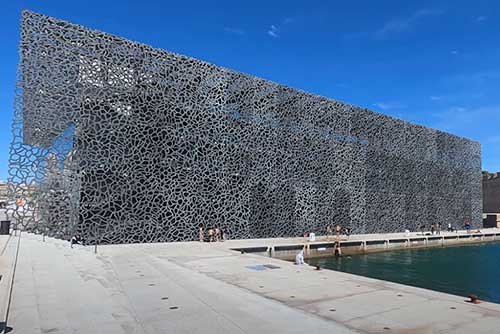
Fort St. Jean, the other of the two forts built by Louis XIV, has been reborn as a museum of European civilizations. Rather than remodeling the fortress itself, a similarly sized building has been built next to it, connecting the fortress and the Musée des Civilisations de l’Europe et de la Méditer ranée, or MuCEM for short. The museum is the first museum dedicated to the history of European Mediterranean civilizations and has become a landmark in Marseille, where it hosts fashion shows, fairs, and conventions. The building’s surface is made of iron, reminiscent of a fisherman’s net, and the architect who designed it was Rudi Ricciotti. Walking across the bridge between old and new, you feel like a time traveler. It’s also easy to get to Fort St. Jean, where you can take in the exhibitions and the views of the city. On the rooftop of the bridge museum, there’s a cafe with a panoramic view of the Mediterranean Sea through the netted exterior walls.
Take a boat trip from Vieux-Port to the neighborhoods

Sunset boat cruise to the Island of Frioul & Chateau d’if
You can take a boat trip to the Château d’If and Calaques National Park, the setting of Alexandre Dumas’ novel The Count of Monte Cristo.
The infamous prison, made famous by Alexandre Dumas’ novel The Count of Monte Cristo, is located on a small island in the Bay of Marseille. It was built between 1524 and 1531 on the orders of King François I to serve as a defense position from the sea. Its elevated position and the surrounding currents made it difficult to escape, so it was used as a prison for political and religious criminals. If San Francisco, USA has Alcatraz Island, Marseille, France has Château d’If.
The Calanques is a long, narrow bay of the sea surrounded by long coastal cliffs, and the 20-kilometer stretch from Cassis to Marseille is the Calanques National Park, which was declared a UNESCO World Natural Heritage Site in 1983.