10 hotspots you must visit in Athens

History is everywhere you look. Even the smallest pebble underfoot is thousands of years old, and a dusty chapel is a historic building that has made its mark. Discover ancient ruins scattered throughout Athens, including golden marble columns waiting to be reconstructed and rocky mountains the size of houses in the Bible, where the glory days of ancient Greece await reconstruction.
The sacred rocky hill,
Areopagus
Greek Mythology Quest Experience in Athens
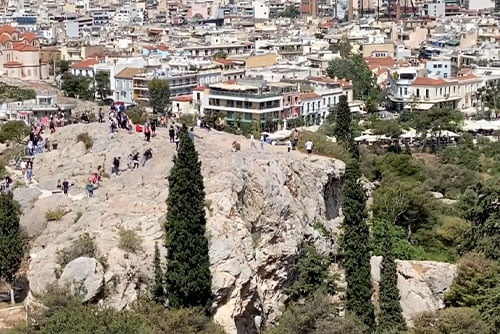
A massive rocky mountain is to the left of the entrance to the Acropolis, on the way to the Temple of Hephaestus. People are constantly climbing up and down the bizarrely shaped stone mountain, and iron stairs have been built for safety. The Areopagus is quite significant to the Greeks. It means “hill of the god Ares” and is named after the god Ares. The Areopagus was the site of a historic courthouse, where trials for murder and injury and meetings of the nobility were held. One of Athens’ political institutions, the Areopagus, also originated here.
Temple of Hephaistos
Ancient Agora of Athens Site & Museum Skip-the-Line Ticket
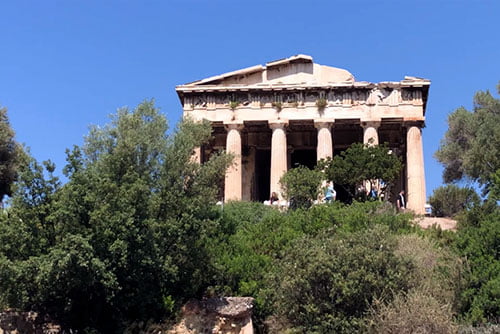
This Doric temple is located on the highest point of the ancient Agora. Standing here, you can see the Acropolis with the Parthenon in the distance. Initially, the temple was called Theseion, which means “temple of Theseus,” in honor of King Theseus. Later, it became known as the Hephaestion when it was realized that it was the temple of Hephaestus, one of the 12 gods of Olympus. Hephaestus is the god of blacksmiths in Greek mythology. The temple is one of the best-preserved Greek temples in existence, with its roof intact.
Roman Agora
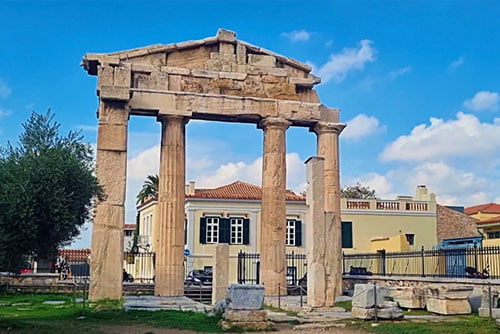
Athens Roman Agora Self-Guided Treasure Hunt & Tour
If you take a leisurely stroll through the Plaka district, you’ll find the Roman Agora at the end of Klepsidras Street, downhill from the Acropolis. After passing through the Gate of Athena Archegetis, built in 11 BC, you’ll see the Fethiye Mosque with its impressive rounded dome roof, the ruins of public restrooms, a colonnade with shops, and the Tower of the Winds. The Fethiye Mosque was built in 1458 to commemorate the visit of Sultan Mehmed II of the Ottoman Empire to Athens and was named after his nickname, Fethiye (Turkish for “conqueror”).
Birthplace of the Modern Olympics:
Zappeion
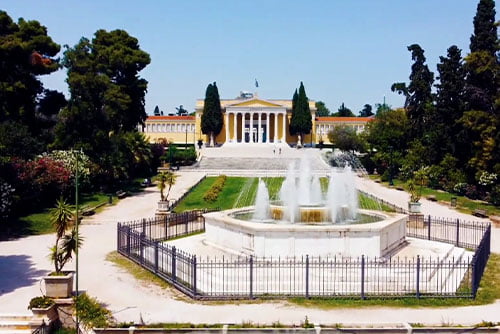
Olympic Games Small-Group Workout and Race in Athens
To the south of the National Garden is the building that served as the headquarters of the first Olympic Games in Athens in 1896. The Zappeion was completed in 1888. Designed by Danish architect Theophil Hansen, it is now used as an international conference center and exhibition hall. On the left side of the building stands a statue of Japas, who donated a huge amount of money to help organize the Olympics. You can also explore the National Garden, which is part of the Zapion. Designed by German palace architect Frederick Schmidt in 1838, the park is home to more than 18,000 species of plants and trees, ponds, and a zoo.
Parthenon
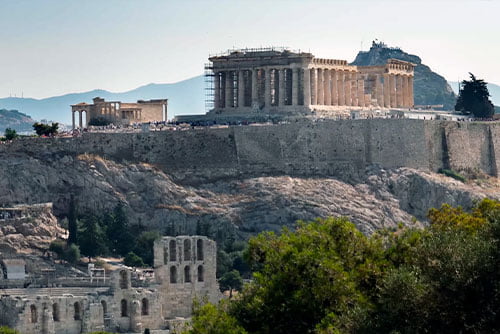
Athens: Acropolis, Parthenon and Acropolis Museum Guided Tour
The crown jewel of Doric temple architecture is the Parthenon. It’s a UNESCO World Heritage Site No. 1. It is considered one of the greatest structures in human history and is used as a symbol of UNESCO.
Dedicated to Athena, the patron goddess of Athens, the Parthenon means “House of the Virgin” in Greek.
It was designed by the architect Ictinus, who also built the Temple of Apollo in the 5th century BC, with the genius sculptor Phidias at the helm, and constructed by Kallikrates. The result is a collaboration between two of the greatest sculptors and architects of their time. The use of the finest material, Pentelic marble, and the gentle curves of the columns, pilasters, and girders gave the temple a grandiose appearance. The temple is 31 meters long and 70 meters wide, with 46 10-meter-high columns in perfect rectangular golden proportions. It was a scientific construction that took a whopping 16 years to complete, even taking into account optical illusions to make the columns appear evenly spaced. However, the ceiling collapsed during the Venetian War in 1687 and was heavily damaged after the Greek War of Independence in 1822.
In addition to losing its original appearance over time, the 12-meter golden statue of Athena was lost, and many of its sculptures were stolen by the British. The Parthenon is still undergoing restoration today.
Stoa of Attalos
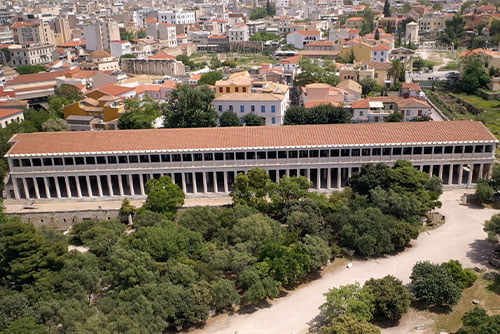
Athens Ticket Pass: Acropolis & 6 Sites with 5 Audio Guides
The Stoa of Attalos is something of an ‘ancient shopping mall’. It was built in the 2nd century BC by Attalos II of Pergamon, a kingdom in Asia Minor, as a gift to Athens, where he spent his student years.
After being abandoned for a while, it was restored in 1953 by Rockefeller II. It is now considered one of the most fully restored ancient Greek monuments.
At 120 meters long, it is the longest structure in ancient Greece, with a spectacular straight stoa (colonnade). The long corridors allowed the ancient Greeks to sit in the shade and hold discussions away from the scorching sun. It is lined with 45 sturdy Doric columns on the outside and 22 Ionic columns with feminine curves on the inside. It’s fun to walk along the corridors and admire the ancient statues. The museum inside the main hall contains artifacts from the Neolithic and Ottoman periods. The water clock used in the Agora court is a particular highlight.
Herodes Atticus Music Hall
Best of Athens Full Day Private Tour
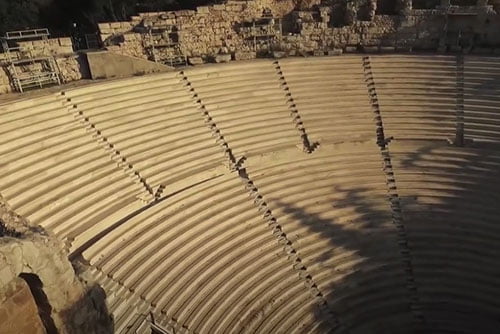
The Herodes Atticus Odeum is a music hall and theater on the way up to the Acropolis. Compared to the Theater of Dionysus, it is relatively circular and intact. It was built in 161 B.C. by Herodes Atticus, a politician who was naturalized in Greece from Rome, as a memorial to his late wife. He loved Greece enough to donate the music hall to the citizens of Athens. Every summer, the Athens Festival is held here, where you can enjoy classical Greek plays, operas, and more.
Tower of the Winds,
a product of ancient astronomical science
Greek Mythology Quest Experience in Athens
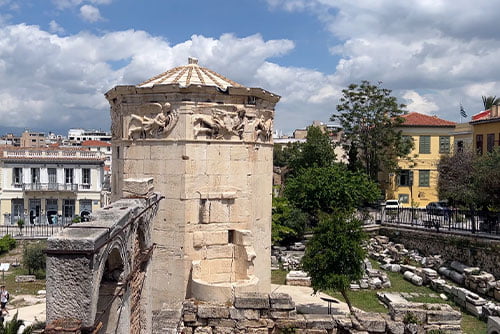
Athenians who met in the Agora often wondered how they could tell the time and how they could know the weather if they couldn’t hear the forecast. The Tower of the Winds in the Roman Agora did just that. The 12-meter-tall Tower of the Winds is a marble octagonal tower built by astronomer Andronicos around 50 BC that served as a weather vane, sundial, and water clock.
The eight sides of the actual tower point to the wind directions. The top of the tower is elaborately carved with the eight wind gods (Anemoi) of Greek mythology: Eurus for the east wind, Apheliotes for the southeast wind, Notos for the south wind, Lips for the southwest wind, Zephyros for the west wind, Skiron for the northwest wind, Boreas for the north wind, and Kaikias for the northeast wind. Inside the tower are eight sundials and a water clock powered by water drawn from the Acropolis. It is the only one of the Athenian temples that has been preserved in its original form.
Meet the King of the Gods,
The Temple of Olympian Zeus
Greek Mythology Quest Experience in Athens
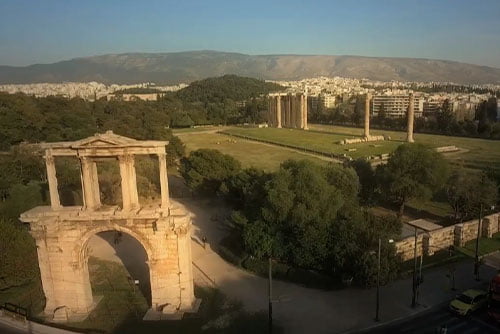
This temple is located to the east of the Acropolis. It’s a very modest structure compared to the Acropolis, with just a few massive stone columns standing in the middle of an empty field. Destroyed by Gothic invasions in the 4th century, only 15 of the 84 columns remain today.
The Corinthian-style Temple of Zeus, whose columns are decorated with Arkansas leaf designs, was dedicated to Zeus, the father of the goddess Athena and the chief of the 12 gods of Olympus. It was begun in the 6th century BC and completed in the 2nd century AD under the Roman emperor Hadrian. Even if you don’t buy a ticket, just standing in front of Hadrian’s Arc is impressive enough.
Arch of Hadrian,
a monumental gate through the ages
Greek Mythology Quest Experience in Athens
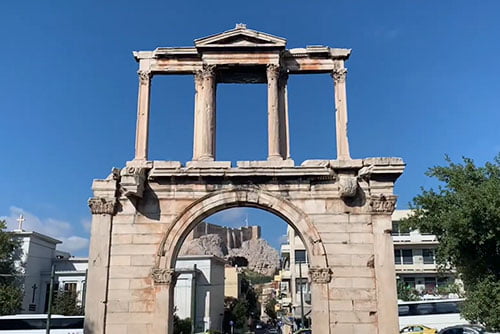
The Arch of Hadrian was built in the 2nd century by the Roman emperor Hadrian to celebrate the completion of the Temple of Zeus. It was built with the same high-quality marble as the Parthenon, Pentelic Marble from Mount Pentelikon in Attica. It’s smaller in scale compared to Rome’s Constantine’s and Titus’ triumphal arches, but it’s no less significant. The lower part of the Arc de Triomphe is Roman and the upper part is Greek.
If you look at the Arc de Triomphe with the Temple of Zeus behind you, you can see the Acropolis on the mountain through the arch, and the words “This is Athens of Theseus” are clearly visible in the center of the arch. On the opposite side, the inscription reads, “From here on out, this is Hadrian’s Athens.