8 hotspots you must visit in Berlin
No trip to Germany would be complete without a visit to the capital city of Berlin.
It has a distinctly Eastern European vibe and is home to some of the most stunning architecture in Western Europe, as well as many delicious restaurants.
There are also plenty of museums and art galleries to explore.
Compared to Western Europe, the cost of living is much lower, so it’s a great place to travel on a budget.
1. Brandenburger Tor
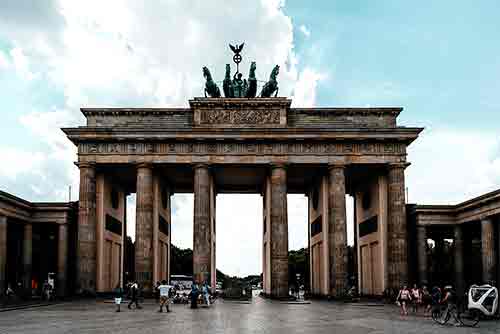
The iconic Brandenburg Gate, Germany’s version of the Arc de Triomphe, was inspired by the Acropolis of Athens and is said to have originally been sculpted as a “quadriga,” a goddess on a chariot drawn by four horses,” representing peace.
It was located on the border between East and West Berlin and served as a symbol of the division.
The middle of the Brandenburg Gate is a slightly wider gate, which was once only accessible to the king or his guests.
In November 1989, a crowd of about 10,000 people gathered at the Brandenburg Gate to watch the unification of West and East Germany, and it was once the site of a parade to boost military morale as a symbol of Nazi power. With so many meanings, it is so widely recognized as a symbol of Germany that it is depicted on the 50-cent euro coin minted in Germany. The “Brandenburger Tor,” also known as the Arc de Triomphe, is a must-see when traveling to Berlin.
2. The Siegessäule
(Berlin Victory Column)
A gleaming golden tower shimmers in the middle of a traffic circle.
It’s the Siegessäule, the Berlin Victory Column.
The Siegessäule was completed in 1872 to commemorate the victory of the Second Schleswig War between the Kingdom of Prussia (now Germany) and Denmark. It also commemorates the subsequent victories of the Kingdom of Prussia against Austria and France. Located in the center of Tiergarten, the 67-meter-high tower is topped by a golden statue of the Goddess of Victory. A narrow spiral staircase winds its way up 20 floors to a small observation deck just below the statue that offers panoramic views of the city.
3. Berlin TV Tower
(Berliner Fernsehturm)
The largest building in Germany is located near Alexanderplatz. The Berliner Fernsehturm is one of the three largest observation decks in Berlin, along with the dome of the Berlin Cathedral and the dome of the Capitol.
From the observation deck, you can see all of Berlin. The rotating observation deck is 203 meters above the ground. If you climb the 270 stairs, you can see the TV tower and the rest of Berlin from here, and you can enjoy a meal at the restaurant on the top floor overlooking all the action.
Ticket Admission to Berlin TV Tower
4. A monument to the murdered Jews of Europe
A monument to the murdered Jews of Europe (Denkmal für die ermordeten Juden Europas)
The Holocaust Memorial is a memorial located in Berlin, Germany, used to commemorate the Holocaust of the Jews of Europe. It was built in 1999 after a design competition organized by the German government selected Peter Eisenman’s design.
This unusual and massive sculpture park can be found on the way from Potsdamer Platz to the Brandenburg Gate. Built to commemorate the Jewish victims of the Holocaust, the monument features 2,711 concrete pillars arranged in an odd configuration.
As you walk the sloping pathway through the forest of pillars, you will feel disoriented and gradually isolated. The building embodies the despair of the Holocaust, and there is a Holocaust-related information center in the basement.
Berlin: Skip-the-line Jewish Museum Private Guided Tour
5. Kaiser Wilhelm Memorial Church
(Kaiser-Wilhelm-Gedächtniskirche)
Located on Kudammstrasse, one of Germany’s busiest streets,. It is called the “rotten tooth” and still bears the scars of a World War II bombing raid.
As a symbol of peace and unity, the church was not renovated, but instead a new hexagonal church was built right next to it as a reminder of the horrors of World War II and to never go to war again.
The new church is made of bluish stone glass, giving the interior a mysterious and magical feel. It was built in the neo-Romanesque style over four years, from 1891 to 1895, to honor the glory of Wilhelm I, Germany’s first emperor. However, it was destroyed by bombings in 1943 and 1945. However, it was not repaired but preserved as it was, as a reminder of the horrors of World War II.
6. Bellevue Palace
(Schloss Bellevue)
Schloss Bellevue is a palace in the Tiergarten district of Berlin, Germany. Originally a neoclassical palace built in 1786 for Prince Ferdinand von Preußen, the youngest brother of King Friedrich II, it has been the official residence of the German President since 1994.
It is located on the banks of the Spree River, near the Siegessäule.
Schloss Bellevue was originally a neoclassical palace built in 1786 for Prince Ferdinand von Preußen, the youngest brother of King Friedrich II, and is now the official residence of the German President. The simple and unpretentious white palace is beautifully set against the green Tiergarten and the Spree Fluss.
7. East Side Gallery
The East Side Gallery is an open-air exhibition hall in Friedrichshain, eastern Berlin, and is the largest open-air gallery in the world at a whopping 1,316 meters long.
It is home to the longest surviving piece of the Berlin Wall, which is displayed open-air and intact, and is famous for the mural “Kiss of Brothers” on the Berlin Wall, which depicts the 1979 meeting between East German Stasi chief Honecker and Soviet Stasi chief Brezhnev.
In 1990, the year after the fall of the Berlin Wall, artists from around the world flew to Berlin and painted 110 large-scale paintings on the wall along the Spree River in Friedrichshain, with themes of reunification, anti-war and peace. The Eastside Gallery is the longest art gallery in the world.
Berlin Wall Self-Drive Trabi Tour
8. Berlin Cathedral, Berliner Dom
Located to the west of the Berlin Museum, the Berliner Dom is an ornate and beautiful building that began construction in 1747. It has blackened walls and a blue dome roof. The cathedral was heavily bombed during World War II and lost much of its original splendor, leaving its current appearance a mere shadow of its former self.
Berliner Dom was originally built as a cemetery for the Hohenzolle family, a prestigious family that produced kings of Prussia and emperors of the German Empire, so you can still find the dazzling coffins of the Hohenzolle family inside.
Organ concerts are often held in the cathedral, which has beautiful stained glass windows and ceiling mosaics. Directly in front of the Berliner Dom is a large grassy garden called the Lustgarten, which provides a place of relaxation for citizens and tourists.The garden was originally a vegetable garden and was later converted into a green space. In the evening, many travelers gather here to admire the night view of the Berlin Cathedral. The former church is now used as a Protestant Lutheran church.