Muscat’s best hotspots and neighborhoods
The capital city of Muscat is a beautiful city on the seaside, with a diverse mix of heritage and modern civilization. Its mix of modern buildings, mosques, and walled ruins glows golden at sunset, making it a highlight of any trip. The magnificent Grand Mosque and the Royal Opera House, with its spectacular nighttime view, are two of Oman’s most famous landmarks.
In the northeast, Wadi Shab is a valley of dry dunes. It’s also known as a trekking destination, although it’s not easy. Travelers love to dive here because of its unusual landscapes, rock formations, and beautiful natural pools that you’ll never see in other countries. The Bima Sinkhole, which was created when water pooled in a sunken area of the earth, is an emerald treasure.
City tours

Group Muscat City Tour
Muscat Town Walls
Built by the Portuguese, the sturdy stone walls surround Muscat City to the west, protecting the city from attacks from inland. The wall has only three gates. Bab Sagir (the small gate) for pedestrians and donkeys, Bab Kabir (the large gate), the central gate for carts and horses, and Bab Mataib (the large gate), which is only used by larger vehicles authorized to travel between Muscat and Mutrah. At one time, different tribes were responsible for guarding the gates.
Royal Opera House
The Royal Opera House is the cultural center of Muscat, hosting performances ranging from opera to ballet.
Built of Omani marble and wood with hand-carved traditional Islamic patterns, it’s also home to a 500-ton pipe organ that was once played by the Sultan himself. The acoustics are so good that experts from London’s Royal Opera House were brought in to create the best possible sound, and people from neighboring countries come to see ballets and operas.
Mutrah Souq
Mutrah Souq is one of Oman’s oldest wet markets, dating back 200 years.
In any country, visiting a souk is a great way to get a glimpse into local culture and life, especially in the Arab world, where the souks are reminiscent of scenes from Arabian Nights.
Mutrah Fort
This fort was built by the Portuguese in the 1580s for military purposes, and the views from the top of the fort are spectacular.
Mutrah Fort sits on a hill overlooking the natural harbor of Mutrah Port and is an impregnable fortress that protects Mutrah and allows for surveillance of the surrounding area.
Al-Alam Palace
In front of the National Museum of Oman, there is a roundabout like this one, and the building on the other end is the Al Alam Palace.
The road to the palace is flanked by long corridors made of marble, giving it a grand and luxurious feel.
Al Alam Palace is one of the six residences of the Sultan of Oman and is used by the Sultan to receive guests.
The palace is over 200 years old and was built using Indian architectural techniques.
The National Museum of Oman
The National Museum of Oman faces the Al Alam Royal Palace. The museum is quite large and has a wide variety of artifacts on display.
It’s a great way to get a glimpse into Oman’s history and culture, so it’s worth scheduling it alongside the Royal Palace.
Other places
Other places to visit in the old city center include the exotic and beautifully tiled Sultan Qaboos Mosque, the Al Mirani Fort, which protects the hill to the east of the palace, and the Al Jalali Fort, which protects the hill to the west.
Wahiba Desert:
A journey into a world of dunes and camels
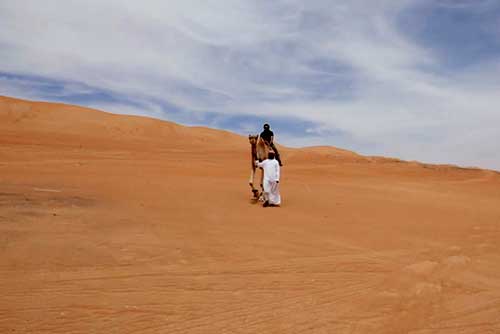
Wahiba Sands and Desert Safari from Muscat
Ride a camel through the endless white desert.
Immerse yourself in the scenery as you feel the thrill of running through the sand.
Visit oases and experience desert culture with a local guide.
Have a campfire under the starry sky at a traditional Bedouin camp. Sway to Omani music and watch local dances.
Wadi Shab,
an Omani treasure

Wadi Shab and Bimmah Sinkhole Group Full Day Tour
A ‘wadi’ is a type of valley terrain. It’s a place where there’s no or only a small amount of standing water during normal times, but when it rains heavily, water flows. There are many wadis in Oman, but one of the most famous is Wadi Sab, which is about an hour and a half drive from Muscat and can be visited as a day trip.
The surrounding landscape is more mystical than 21st-century, like something from the distant past when dinosaurs lived here or somewhere in the far reaches of space that humans have yet to reach.
You’ll need to take a small boat from the parking lot at the entrance to Wadi Sap and trek from there. It takes more than 40 minutes of walking to reach the destination, crossing stagnant water along the way. You’ll need to swim in the caves inside Wadi Sap, so it’s best to wear a swimsuit and aqua shoes.
turquoise temptation,
bimah sinkhole

Wadi Shab and Bimmah Sinkhole Group Full Day Tour
About an hour and a half drive from Muscat is Bimah Sinkhole Park. It is a sinkhole, as the name suggests, with holes measuring 50 and 70 meters, respectively, about 20 meters deep, and the mysterious turquoise color of the water that fills them is very impressive.
It’s not just a sinkhole in the middle of nowhere, though; the area around it has been developed into a park, and there are plenty of places to sit and relax along the park’s trails, where you can see plants unique to the Middle East.
You can also take the stairs down to the bottom of the sinkhole to get a closer look at the mysterious colors of the water. Jumping into the sinkhole is prohibited, but swimming is free.