8 hotspots you must visit in Florence
When we think of the Renaissance, we think of Florence. Arguably, Florence is the city where the Renaissance blossomed the most: the footsteps of Renaissance philosophers, artists and scientists are everywhere, and the entire city is a living, breathing museum.
When you think of Florence, the Duomo (the round dome is called the Cupola) of Florence Cathedral is the first thing that comes to mind, or the solemnity of Santa Croce Church, where 276 of Florence’s greatest minds, including Michelangelo, Galileo Galilei, Machiavelli, and Leonardo da Vinci, are buried. A tour of the Ponte Vecchio and Dante’s House, reminiscent of Dante and Beatrice, will evoke the elegance of classical literature and the poignancy of love, or the majesty of the Medici family, who were proud to be the home of the Renaissance and patrons of art and culture.
1. Ponte Vecchio
(Vecchio Bridge)
Florence Sightseeing Walking Tour with a Local Guide
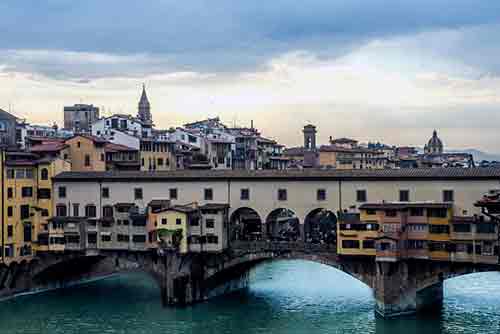
Ponte Vecchio is the oldest known bridge spanning the Arno River (Fiume Arno). It is one of Florence’s most iconic tourist attractions and landmarks, attracting many visitors with its distinctive jagged rows of shops over the bridge.
It’s also very close to Piazza della Signoria, Palazzo Vecchio, and the Galleria degli Uffizi, all of which are a must-see part of any trip to Florence, so it’s a good idea to combine them.
The arched bridge over the Ponte Vecchio is always bustling with people, with many jewelry and souvenir shops to choose from. Although it’s now a lively tourist destination, the area was once home to a butcher shop, blacksmith shop, and more. In 1593, Ferdinand I expelled them for being too noisy and foul-smelling, and the space was later occupied by goldsmiths.
Ponte Vecchio, Ponte alle Grazie, Ponte Santa Trinita, and more. The bridges over the Arno River are also famous for their beautiful sunsets.
Watching the sky slowly turn red from the bridges is a romantic memory. If you have the time, try walking along the Arno River at sunset with your loved one. You’ll be sure to have a romantic time.
2. Pitti Annex
(Palazzo Pitti):
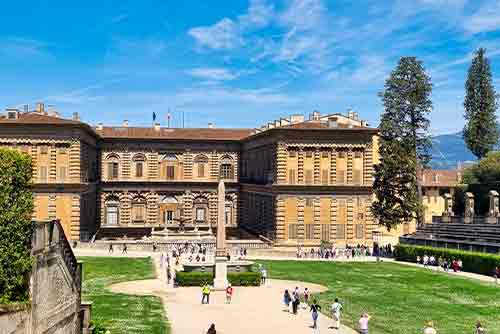
Pitti Palace Small Group Tour
The Pitti Palace is located across the Arno River. It served as the main palace of the Medici family and was expanded several times to include the Boboli Gardens. The palace itself is huge and gorgeous, and the Boboli Gardens are so large that you could spend a whole day exploring all of the Medici family’s collections.
In particular, the Paratici Gallery, located inside, is a must-see. The real treasures of the Pitti Palace are the paintings that adorn the walls of the rooms from floor to ceiling, masterpieces by masters of Renaissance and Baroque art such as Raphael, Titian, Correggio, Caravaggio, Rubens, and others. All of the works are framed in lavishly decorated gilded cabinets, as befits a majestic residence.
Boboli Garden is located behind Palazzo Pitti. This park is filled with beautiful gardens and sculptures. It’s a great place to enjoy a leisurely stroll in Florence.
Built during the height of the Medici family’s rule in Florence in the 16th century, the Grotta del Buontalenti is the largest cave in the city. The mythical creatures and man-made stalagmite sculptures that cover the facade and interior make the grotto one of the most popular parts of the Boboli Gardens.
3. Florence Cathedral
(Cattedrale di Santa Maria del Fiore):
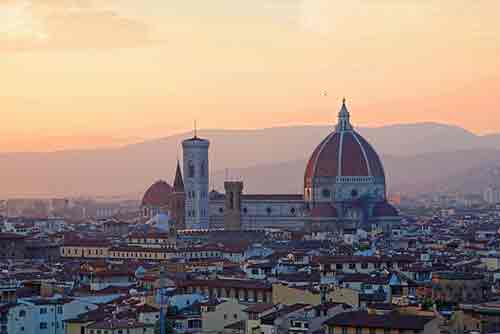
Cathedral Complex with Dome
Famous for its dome designed by Brunelleschi, the exterior is clad in marble from different regions, including white and outlined green and pink.
The cathedral is Gothic in style and is known for its stunning stone work and beautiful frescoes. The Column of Justice, a work by Christophe Columbus, can also be seen here. The Duomo is famous for its cupola, which is a rounded roof (dome). The dome was designed by Filippo Brunelleschi.
The Duomo’s cupola can be climbed on foot, with 463 stone steps spiraling upward. There are always a lot of tourists trying to climb the cupola, so once you step onto the steps, you can’t stop walking, even if the people behind you are struggling to keep up.
The ceiling painting inside the cupola, “The Last Judgment” by Giorgio Vasari, is a stunning sight to behold. It also shows the trend of late Renaissance painting away from unnaturalistic depictions of the human body and towards mannerisms.
4. Baptistery of San Giovanni Battistero di San Giovanni & Giotto’s Bell Tower
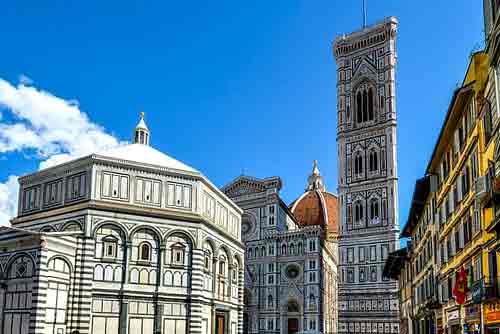
Florence panoramic view Giotto’s Bell Tower and Cathedral Ticket
Across Piazza del Duomo and opposite the cathedral is the Baptistery of St. Giovanni, the oldest religious building in Florence, whose interior decoration is attributed to Giotto.
The Baptistery of St. Giovanni is the oldest religious building in Florence. The current building is an octagonal structure rebuilt between 1060 and 1150 on the site of an ancient baptistery from the 4th century. It is decorated with white and green marble. The Baptistery was built in honor of St. Giovanni, the patron saint of Florence. It served as Florence’s cathedral before the Duomo was completed.On the east side of the baptistery is a bronze door with a relief of St. John the Baptist by Andrea Pisano, made in 1336. During the Black Plague, the Florentine Weavers’ Association decided to place a new bronze door on the baptistery to invoke heaven’s favor. Giberti was chosen in a competition, and over the course of 20 years, he completed the New Testament bronze door, which consists of 28 small screens. Upon completion, the New Testament bronze door was placed on the east side of the baptistery, while the John the Baptist bronze door was moved to the south.
The Weavers’ Association also commissioned Giverti to create a relief north bronze door for the Old Testament, and he completed ten large screen bronze doors, beginning with the creation of the world and ending with the marriage of Solomon and the Queen of Sheba. The previous east bronze door for the New Testament was moved to the north, and the bronze door for the Old Testament was placed in its place, facing the front of the Duomo. The bronze door has the face of a balding, middle-aged man, Giberti, sculpted in the center. Above the Old Testament bronze door is The Baptism of Christ by Andrea Sansovino.
It is said that many of the greatest artists of the Renaissance, including Dante and Giotto, were baptized in the water of this baptistery.
If you look up at the ceiling of the baptistery, you’ll see a skylight in the center and a mosaic of the octagonal dome depicting biblical scenes: Christ the Judge, a celestial diagram, and biblical episodes.
Giotto’s bell tower is a collaboration between the Florentine painter Giotto and his pupil Andrea Pisano. Giotto began building the bell tower in 1334 and completed the foundation and first floor before dying, and his pupil Pisano raised it to the third floor and decorated it with tricolor marble in red, white, and green. The reliefs in the panels at the bottom of the bell tower are by Pisano. It was completed in its present form in 1539.
5. Piazza della Signoria:
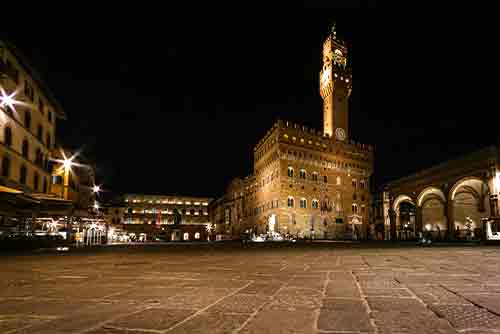
Private Guided Walking Tour of Florence
Piazza della Signoria is a square in Florence, Italy. It is central to the origins and history of the Florentine Republic, and still maintains its reputation as the political center of the city. It is located in front of the Uffizi Gallery and Palazzo Vecchio, and statues relating to Florentine historical events stand throughout the square.There is a bronze plaque commemorating Girolamo Savonarola, who was executed here.
On the other side of Palazzo Vecchio, towards the Uffizi Gallery, is the Loggia dei Lanzi, a corridor of statues.
There are 15 statues in this corridor, which are said to represent figures from ancient Greco-Roman mythology.
There are many statues throughout the piazza, but they are all copies.The real ones are all over the museum.
It is said that in the old days, there were almost real statues, but they were replaced with copies to preserve them.
Statues in the piazza
5-1 “Statua del David” by Michelangelo Buonarroti, entrance to Palazzo Vecchio; Michelangelo’s original is housed in the Accademia Gallery, adjacent to the Florence Academy of Fine Arts.
5-2 Statua equestre di Cosimo I de’ Medici, sculpted by Giambologna in honor of Cosimo I de’ Medici
5-3 Fontana del Nettuno by Bartolomeo Ammannati
5-4 The Marzocco now in Piazza della Signoria, a replica of Donatello’s
5-5 Judith and Holofernes, by Donatello (replica)
5-6 Abduction of a Sabine Woman by Giambologna, (1583) (Rosa dei Ranchi),
5-7 Perseus with the head of Medusa by Benvenuto Cellini (1554) (Rosa dei Lanzi)
5-8 Medici Lion by Giovanni di Scherano Fancellii (1589)
Address: P.za della Signoria, 50122 Firenze FI, Italy
6. Palazzo Vecchio in Piazza della Signoria
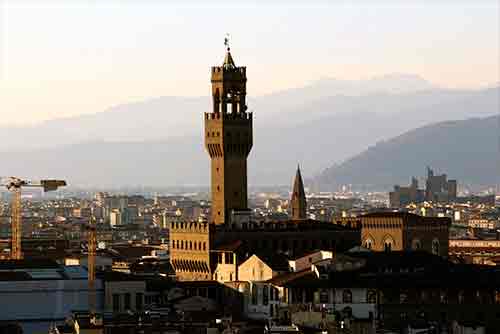
PALAZZO VECCHIO: Private tour in Florence
In the 16th century, Cosimo I (1519-1674) of the Medici family, who ruled Florence, stayed in the Palazzo Vecchio but later moved to the Palazzo Pitti across the Arno River, leaving the Palazzo Vecchio to become a palace of the past. ‘Vecchio’ means ‘Old’ and literally translates to ‘old palace’.
The Palazzo Vecchio (‘Old Palace’) is the city’s town hall.
This massive Romanesque fortified palace is one of the most impressive town halls in Tuscany. Overlooking the piazza with Michelangelo’s statue of David and the adjacent Gallery of Statues in the Rosa dei Lanzi, it is one of Italy’s most important historic sites and houses cultural attractions and museums.
Originally called the Palazzo della Signoria, it was named after the Signoria of Florence, the governing body of the Florentine Republic. During its long history, the palace was also given several other names, such as Palazzo del Popolo, Palazzo dei Priori, and Palazzo Ducale, depending on its various uses.The building received its current name when the residence of the Medici dukes was moved across the Arno River to the Pitti Palace.
From 1865 to 1871, it was home to the Parliament of the Kingdom of Italy, and today it houses the Mayor of Florence and several municipal offices.
Upon entering the palace, you’ll find the most famous Room of the 500, with its overwhelming ceiling paintings and numerous dazzling paintings on the walls. The name is said to have come from the Committee of 500, who were in charge of municipal affairs at the end of the Florentine Republic. There is also a museum where you can visit magnificent rooms with works by Agnolo Bronzino, Ghirlandaio, and Giorgio Vasari, as well as works by Michelangelo Buonarroti, Donatello, and Verrocchio.
7. Michelangelo’s Hill
(PIAZZALE MICHELANGELO)
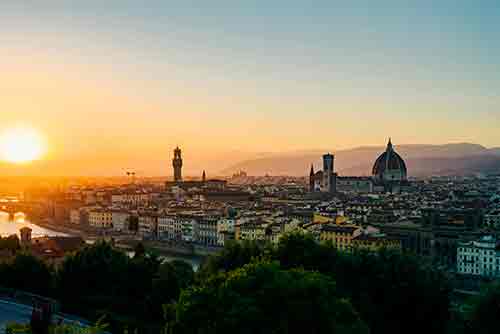
Electric Vespa self-drive Tour of Florence Hills with local products Tasting
A hill with beautiful sunset and night views
Piazzale Michelangelo (Piazzale Michelangelo)The walk from Piazza del Duomo to Piazzale Michelangelo across the Arno River bridge takes about 30 minutes on Google Maps, but it takes longer.
It’s a lot of walking up and down hills, so comfortable shoes are a must. I recommend taking bus number 12 from Santa Maria Novella station.
The hill, greeted by Michelangelo’s statue of David, is a great place to get to before sunset, see the sun go down and come back up at night, and feel all of Florence.
Don’t miss out on the view of Florence city center and the Arno River by climbing Michelangelo’s hill!
From Michelangelo’s Hill, you’ll have a great view of the center of Florence, including the Cattedrale di Santa Maria del Fiore and the Campanile di Giotto, the Palazzo Vecchio bell tower on Piazza della Signoria, and the city of Florence with its red-tiled roofs.
8. Museum of the Opera del Duomo
(Museo dell’Opera del Duomo)
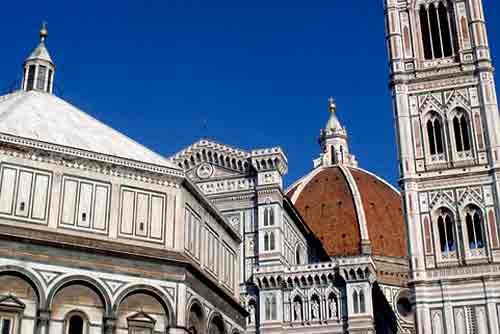
Florence Baptistery The Opera del Duomo Museum: Tour with Brunelleschi’s Dome
Opened in 1891, what is now called “one of the most important sculpture collections in the world” is . The Duomo Opera Museum was founded to house artwork from the Duomo, the Campanile of Giotto, and the Baptistery of San Giovanni in Florence, and it is said that the artwork in the Duomo, the Campanile of Giotto, and the Baptistery are copies, while the pieces in the museum are originals.
Among the museum’s collections is the Lamentation of the Dead Christ, which Michelangelo carved for his own tomb. The door to the baptistery of Florence Cathedral, called the Gate of Paradise by Lorenzo Ghiberti, is also located here.