You must-visit attractions in Yerevan area
Yerevan is the capital of Armenia. It is backed by Mount Ararat, which is considered sacred by Armenians.
It became the capital in 1918 and is located at an altitude of about 1000 meters above sea level.
3 Must-See Places to Visit in Yerevan City
Private City Tour of Yerevan
Cascade Viewing Platform
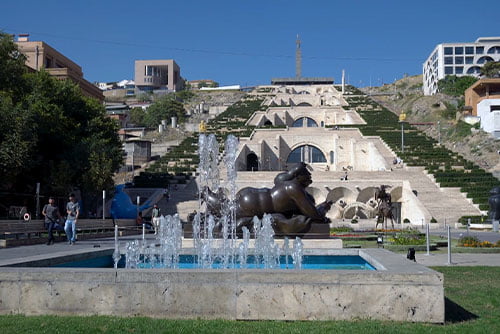
Cascade, which means ‘small waterfall’, is Yerevan’s top attraction. From the top, you can see the city of Yerevan and Mount Ararat.
The Cascade is a 450-meter-high, 572-step staircase built into the hill, with a sculpture park in the middle.
It’s a popular date spot for travelers and locals alike, and there’s an art museum inside. You can take the external staircase or the internal escalator to the top. On either side of the escalator are galleries with sculptures and installations. Cascade also houses the Capesjan Museum of Art within the complex, and the plaza in front of it is filled with works by many famous artists. If you climb it at sunset, you’ll get to see both the sunset and the night view of Yerevan.
Freedom Square
The stunning building in front of you is the Armenian Opera Theater.
On weekends, there are opera performances and Yerevanites wait to enter the theater.
Heading west from here, you’ll find the red church of the Holy Mother of God, St. Giorgos.
Plaza of the Republic of Yerevan, Armenia
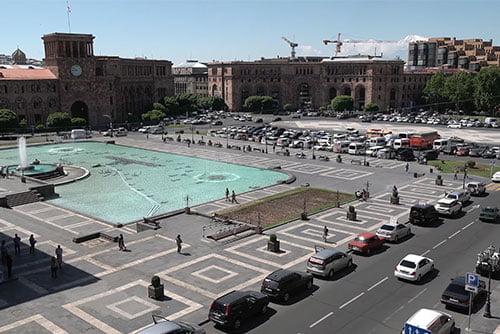
The central town square of Yerevan is an oval-shaped square where the museums, the National Gallery, and other institutions are concentrated.
The square was designed and built by Alessander Tamanian in 1924, and most of the buildings were completed in the 1950s, with the last building, the National Art Museum, completed in 1977.
The buildings around the square are made of pink and yellow limestone on a base made of basalt. Described as an “architectural highlight” and an “architectural ensemble,” Republic Square is the most important civic space in the city of Armenia, where political rallies, demonstrations, celebrations, and cultural events are held. The musical fountain in front of the History Museum and the National Gallery is a highlight after dark. Many people line the square, waiting to watch the fountain show. The Republic Square Fountain Show is a majestic and colorful show with music that runs for 30 minutes starting at 9pm.
Lake Sevan
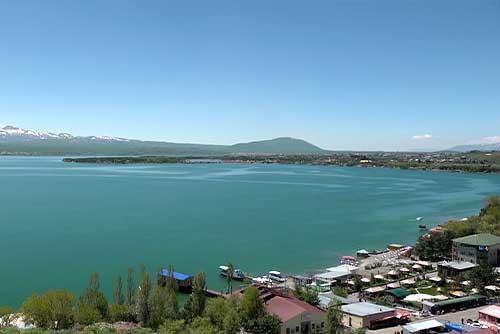
Lake Sevan – Blue Pearl of Armenia
Lake Sevan is the largest lake in Armenia, as well as in all three Caucasus countries.
It was formed by a volcanic eruption of the nearby Mount Ararat, which means “black lake” in the local language.
Since Armenia has no sea, many Yerevan residents vacation at Lake Sevan, especially in the summer.
Travelers enjoy trekking among the dotted monastery ruins and the lake as a backdrop.
Khorvirap Monastery and
views of Mount Ararat
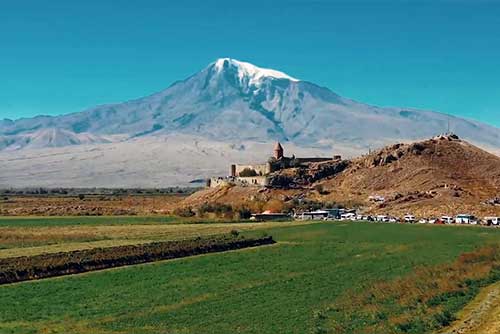
Private Half-Day Khor Virap Monastery & Mount Ararat view Tour from Yerevan
Arriving at Khorbirab Monastery, you’ll get a view of Mount Ararat, which straddles Turkiye, Iran, and Armenia.
At 5.137 meters, Mount Ararat is the biblical mountain where Noah’s Ark arrived and the holy mountain of Armenia. The mountain is high and rugged, with 30% of its summit covered in ice caps. However, although Mount Ararat is the holy mountain of Armenia, it was given to Turkiye by Lenin during the Soviet Union and now belongs to Turkiye.
Harkats is a cross-shaped stone that is worn as a sign of faith and to pray for the well-being of oneself and one’s family.
Korvirap Monastery was built on the site of the dungeon where St. Gregory the Great was buried; Korvirap means “dungeon, deep pit”.
It is said that St. Gregory, who was influential in the adoption of Christianity as the state religion of Armenia, was imprisoned for 14 years, and when Tiridades III, who imprisoned him, fell ill, St. Gregory healed him and the monastery was built on top of him. It was the first place in the world to recognize Christianity (in 301). Associated with mysticism, biblical events, and Armenia’s Christian history for more than a millennium, Kovirap Monastery attracts pilgrims from abroad because of its majestic openness to the sacred Mount Ararat and its mesmerizing views.
Armenian Gaghad Monastery
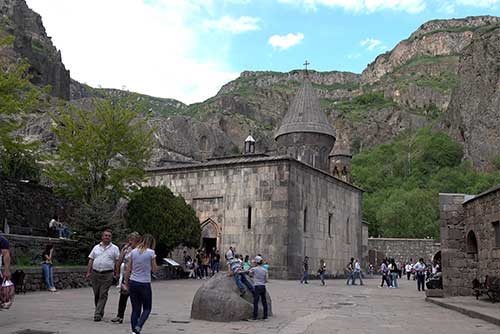
Group tour: Garni Temple, Geghard Monastery and Master Class
A 2,000-year-old UNESCO World Heritage Site, Gaghad Monastery was founded in the 4th century by St. Gregory in a cave that contained a holy spring. The rock-cut church and cemetery preserve the architectural and decorative arts of medieval Armenian monasticism.
Monasteries of Haghpat
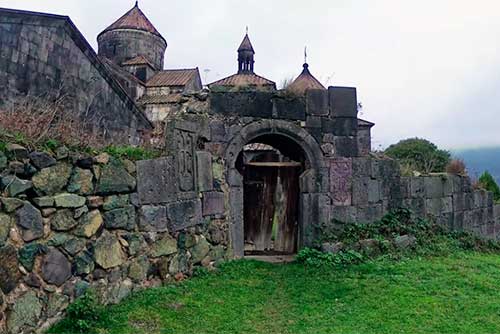
Haghpat,Sanahin,Akhtala
Monasteries of Haghpat is a monastic complex that includes the Church of the Holy Cross, the Church of St. Gregory the Great, the patron saint of Armenia, the 13th-century royal-named Church of Hamazakh, the Church of the Virgin Mary, a manuscript room, and a three-story bell tower.
Above the Debed Gorge in the Lori region bordering Georgia, the Byzantine Monasteries of Haghpat was an important educational institution for the thriving Kiurik dynasty from the 10th to 13th centuries. Construction began in 966 and was completed in 991, but the monastery has been continuously restored to preserve its original form, following destruction by the Arab Seljuks in the 12th century and the Mongol invasions in the 13th century.
The most important ‘hatskar’ in the Monasteries of Haghpat
Built in 1273 between the Church of the Holy Cross and the Hamazahab Church, the Hatskar of the Savior depicts the entire life of Jesus Christ, from his birth to his death on the cross.
Garni Temple
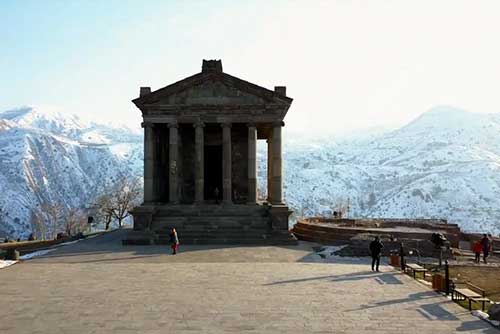
Group tour: Garni Temple, Geghard Monastery and Master Class
The Temple of Garni is said to have been built around the 1st century under the patronage of Emperor Nero.
It was originally dedicated to the sun god Mithras but was converted to Islam-Christianity by the ruling power, and is modeled after the Parthenon. It was destroyed by an earthquake in 1679 and restored in 1975.
When Christianity was recognized in Armenia, all idol temples were torn down, and this is the only one left standing. Below the temple, a river flows through the gorge of Azatjusanjuli.