5 hotspots you must visit in Riga
Riga has been called a fairytale city, and it’s a beautiful city with charming architecture and historical monuments scattered throughout.
Here, old buildings and modern architecture blend harmoniously to create a unique charm.
Swedish Gate
Best Of Riga Walking Tour: Old Town
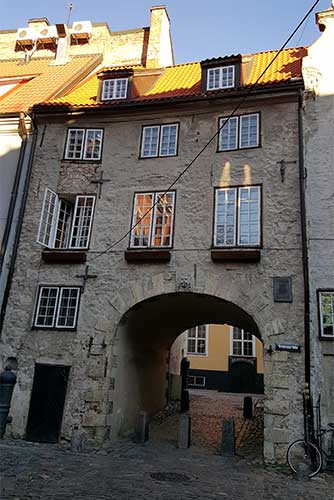
During the Middle Ages, Riga was a walled city surrounded by walls and 25 gates. The Swedish Gate was built to celebrate the Swedish conquest of Latvia, and while there were eight gates in total, only one remains today. Just a few years after the Swedes built this gate, Latvia fell under Russian control. Always at the mercy of foreign invasions, Latvia was oppressed by the Soviet Union from 1940 onward and only joined the West after the collapse of the Soviet Union in 1991. Latvia just celebrated its 100th anniversary of independence this year.
Passing through the Swedish Gate leads to Troxnu Street, which means ‘Street of Noise’. The alleyway dates back to the 13th century and was once bustling with merchants, but today it is one of the narrowest and quietest alleys in Riga. There are many attractions in the neighborhood, including Sculpture The Ghost, Jacob’s Barracks, Latvian War Museum, and Reveal Riga.
The Three Brothers Building
Trīs Brāļi
Riga Old Town Walking Tour
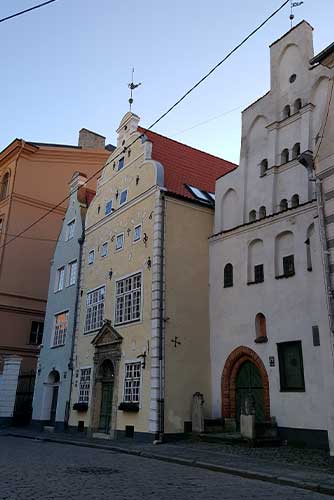
As you wander the alleys of Riga’s medieval Old Town, you’ll come across three unusually touristy buildings. They’re called the Three Brothers Buildings.
They’re three buildings of different shapes, all close together. They are three houses built over three centuries, starting in the 15th century, standing shoulder to shoulder. They are also called living architectural museums because they show the evolution of Latvian architecture at a glance. Which of the three is the older brother? The white building on the right is the oldest, built in the 15th century, while the ones to the left are 100 years old. The later buildings are smaller in scale because of the lack of land in the old town. The oldest building has the smallest windows, as taxes were collected based on the size of the windows. The building also houses an architectural museum. From the left side of the building, you can see the 18th-century Baroque, 17th-century Dutch Mannerist, and 15th-century Gothic buildings!
The Three Brothers building is now home to the State Heritage Protection Inspectorate and the Latvian Architecture Museum. The Latvian Architecture Museum has a wide range of collections, including a collection of Latvian architectural heritage, so it’s worth taking your time to explore.
Steeped in history,
The house of Blackheads
Join-in Shore Excursion: Sightseeing Tour of Riga
Our tour of Riga’s Old Town begins at Riga Town Hall Square.
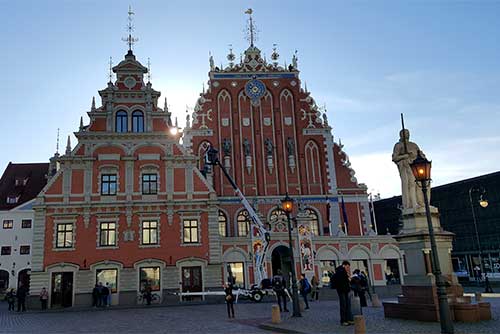
In the center of the square, you’ll find an unusual structure that stands out. It’s called the Hall of Blackheads, and it’s an iconic landmark of Riga’s Old Town, with its red brick façade and weather vane at the top. It’s also considered one of the most beautiful pieces of architecture in the city. It’s a Gothic building with some of the most lavish decorations in the Old Town.
It was first built in 1331 but was destroyed and rebuilt repeatedly throughout history, including being bombed by the Germans during World War II and demolished during the Russian occupation, before being rebuilt in 1948. The Black Head Hall is so named because it was the home of the Black Head Guild, an organization of young merchants who traded in Africa and South America in the 15th century.
In front of Black Head Hall is the site of the world’s first Christmas tree. According to legend, tree culture originated in the winter of 1510, when members of the Black Head Guild erected a giant fir tree and partied all night. In front of the Black Head Hall, on the Town Hall Square, stands a statue of Roland, who was revered as the patron god of Hanseatic League traders.
If you want to capture Riga at a glance,
St. Peter’s Church
An audio tour of Old Riga: from St Peter’s Church to the Monument of Freedom
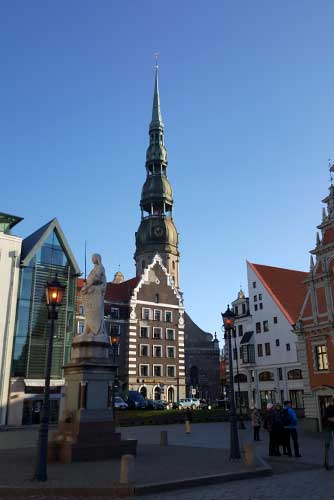
This is the first church in Riga to have a weather vane in the shape of a rooster hanging from each spire. There is an observation deck 72 meters up the 123.5-meter-high spire. You can reach it in a short elevator ride rather than a narrow stone staircase. It has survived centuries of hardship. At the end of the 14th century, it was struck by lightning and damaged several times. It was restored during the Russian occupation, collapsed again during World War II, and after several renovations, it was transformed into a spire with an elevator in 1973. Standing on the spire’s observation deck, you can see the Riga skyline from the Old Town, across the Daugava River, to the Latvian National Library. We recommend first taking in the view from the omniscient author’s perspective and then exploring the nooks and crannies of the Old Town.
Rundāle Palace Museum
Private day trip to Rundale Palace, Hill of Crosses & more
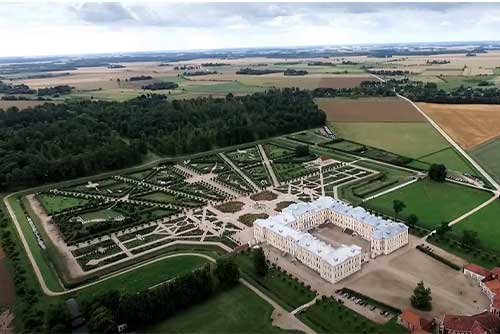
If France has the Palace of Versailles, Latvia has Rundle Palace.
The palace is located in Bauska, just over an hour’s drive from the capital city of Riga.
It was actually modeled after the Palace of Versailles in France. The palace is a classic example of Baroque architecture and features 138 ornate rooms, a museum, and beautiful French gardens.
The main attraction is the palace itself, which has 138 rooms with an opulent and grandiose atmosphere, and while you can’t realistically visit all of them in a day, we recommend that you visit the Golden Hall. This room is said to be the “epitome of opulence” because it is decorated entirely in gold and is the most popular room among tourists. Apart from this, you can also see the magnificent stucco decorations and frescoes in the Baroque style.
You can even see with your own eyes the bedroom of Ernst Johann von Biron, who personally ordered the construction of the Rundale Palace, and the vast gallery of the Duke and Duchess.
The red building in Riga’s old town is almost as colorful as the Hall of Black Hair.During the summer months, the French gardens host a series of spectacular festivals. You can even try on medieval clothing worn by European Latvian nobility in the 18th century.With its long winters, Latvia’s summer season is a time of celebration.
Rundale Palace is a large site, so it’s best to plan your visit in three sections: the palace, the museum, and the French garden.
Other places to visit include The Freedom Monument; Riga Cathedral, a medieval Lutheran church built in Romanesque, early Gothic, and Baroque styles; the Riga Ghetto and Latvian Holocaust Museum; the Central Market, Europe’s largest market and a UNESCO World Heritage Site; the Panorama Riga Observation Deck, a Soviet-era historical building with a 368.5-meter observation deck; and the KGB building, also known as the Corner House.